Whitewashed Dreams and Azure Domes: Santorini’s Architecture Will Steal Your Breath
Have you ever seen a place so picture-perfect it looks photoshopped? Santorini does that to people. Its architecture—gleaming white cubist houses cascading down cliffs, crowned by blue-domed churches—is more than aesthetic; it’s a harmony of survival, culture, and sunlight. Built to withstand earthquakes and maximize cool interiors, these structures now serve a new purpose: stopping scrolls and sparking wanderlust. This is architecture not just to live in, but to be felt, shared, and remembered.
The Visual Language of Santorini: More Than Just White and Blue
Santorini’s architectural identity is instantly recognizable, yet its origins are deeply rooted in practical necessity rather than aesthetic intention. The island’s dramatic landscape, shaped by volcanic activity over thousands of years, demanded a building style that could endure extreme conditions. The traditional cubist homes—simple, geometric, and tightly clustered—were born from this need. Constructed primarily from local volcanic stone, these houses are inherently resilient, their low profiles and thick walls offering natural insulation against the fierce Aegean sun and seasonal winds. The flat roofs, once used for drying crops and collecting rainwater, now serve as private terraces with panoramic views, blending historical function with modern luxury.
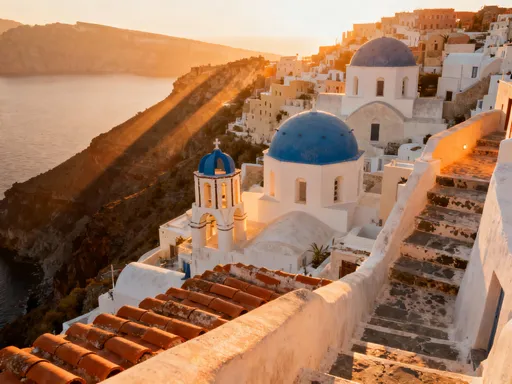
The iconic white wash that covers nearly every surface is more than a design choice—it is a scientific response to climate. The brilliant lime-based coating reflects up to 80% of the sun’s rays, significantly reducing indoor temperatures during the long summer months. This practical solution has become a defining visual element, creating a canvas so pure that even the smallest details stand out. The contrast with the deep cobalt blue of domes, doors, and window frames is striking, but not arbitrary. Blue holds cultural and spiritual significance in Greek tradition, often associated with protection, the divine, and the vastness of the sky and sea. In Santorini, it also serves a visual function: enhancing depth and drawing the eye along winding pathways and cliffside facades.
What makes Santorini’s architecture truly unique is its uniformity across villages. From Fira to Oia, Imerovigli to Megalochori, the design language remains consistent, creating a cohesive visual narrative that feels almost dreamlike. This harmony wasn’t enforced by decree but evolved organically from shared environmental challenges and cultural continuity. Today, local regulations preserve this aesthetic, ensuring that renovations and new constructions adhere to traditional forms, colors, and materials. The result is a living museum of functional beauty—one where every building contributes to a greater artistic whole, inviting travelers to step into a world where form and function exist in perfect balance.
Oia: Where Every Corner Is a Photo Op
If Santorini is a postcard, Oia is its most celebrated image. Perched at the northern tip of the island, this village is synonymous with breathtaking views, golden sunsets, and architectural perfection. Its narrow, winding streets are lined with whitewashed homes that seem to grow directly from the volcanic rock, their curved doorways and arched niches leading to hidden courtyards and intimate balconies. The most photographed spot—a blue-domed church framed by the caldera and the endless Aegean Sea—is not just a landmark but a symbol of the island’s timeless allure.
Oia’s architecture is a masterclass in space optimization. Carved into the soft tuff cliffs, many homes are actually cave houses, naturally cool and acoustically insulated. These dwellings, once modest shelters for fishermen and farmers, have been transformed into luxury accommodations without losing their essential character. Their interiors feature vaulted ceilings, hand-plastered walls, and minimalist decor that enhances the sense of calm and continuity with the landscape. Externally, every balcony, staircase, and rooftop is positioned to capture light and view, making even the most private spaces feel like curated stages for photography.
The village’s global fame has only intensified its visual appeal. Local businesses, from boutique hotels to family-run cafes, have learned to embrace their surroundings as part of their brand. Infinity pools are designed to mirror the sea below, while restaurant terraces are angled to frame the sunset. Yet, despite the crowds, Oia retains a quiet dignity. Residents maintain their homes with care, and strict building codes prevent commercial overreach. The daily ritual of sunset viewing—when tourists gather along the castle ruins to watch the sun dip below the horizon—has become a shared experience, not just a photo opportunity. In that golden hour, as light washes over the white walls and turns the domes into glowing sapphire silhouettes, Oia reveals its true magic: a place where architecture, nature, and human emotion converge.
Fira’s Urban Charm: A Different Kind of Glamour
While Oia captivates with its serene elegance, Fira—the island’s capital—offers a more dynamic interpretation of Santorini’s architectural identity. Perched along the central caldera rim, Fira blends tradition with urban vitality, serving as the island’s transportation, commercial, and cultural hub. Its architecture reflects this duality: multi-level buildings cling to the cliffside, connected by staircases, elevators, and footpaths that weave through the town like threads in a tapestry. Unlike Oia’s quieter, more contemplative atmosphere, Fira pulses with energy, yet it remains visually cohesive, its white-washed facades and blue accents maintaining the island’s signature style.
The town’s layout is a testament to adaptive design. Homes and hotels are built into the rock, their interiors cool and sheltered, while their exteriors open onto terraces that command sweeping views of the caldera. Narrow alleys lead to hidden courtyards, where bougainvillea spills over stone walls and cats nap in the shade. Fira’s main street, a mix of souvenir shops, art galleries, and restaurants, is lined with neoclassical buildings that hint at the island’s 19th-century prosperity. These structures, with their wrought-iron balconies and symmetrical facades, add a touch of historical grandeur to the otherwise minimalist landscape.
What sets Fira apart is its balance between function and beauty. It is possible to live a full day here without ever leaving the caldera edge—shopping, dining, and sightseeing—all while immersed in the island’s architectural poetry. The cable car from the old port, the funicular, and the donkey path (though less used today) all converge here, making Fira the gateway for most visitors. Yet, despite its accessibility, the town retains an air of sophistication. Hotels integrate seamlessly into the cliffs, their infinity pools and glass railings enhancing rather than disrupting the natural lines of the terrain. Fira proves that Santorini’s aesthetic is not limited to quiet villages—it can thrive in a more urban context, offering both convenience and visual splendor.
Hidden Gems Beyond the Hotspots: Imerovigli and Megalochori
For travelers seeking a quieter, more intimate experience of Santorini’s architecture, the villages of Imerovigli and Megalochori offer refined alternatives to the more crowded Oia and Fira. Imerovigli, often called the “balcony to the Aegean,” sits at the highest point of the caldera, providing unparalleled views with far fewer visitors. Its architecture is a subtle evolution of the island’s style—more spacious, more luxurious, yet still deeply rooted in tradition. Cave houses here are often part of boutique hotels, featuring private plunge pools, floor-to-ceiling windows, and terraces that seem to float above the sea.
What makes Imerovigli special is its sense of serenity. The pathways are wider, the buildings more spread out, allowing for greater privacy and contemplation. The Church of St. Nikolaos, perched on a rocky outcrop, is a prime example of how religious architecture blends with the landscape. Its white dome and bell tower rise gracefully from the cliff, visible from miles away yet feeling intimately connected to its surroundings. Because the village is less commercialized, it attracts travelers who appreciate architecture not just as a backdrop but as an integral part of the travel experience.
Megalochori, located inland, offers a different kind of authenticity. This traditional village preserves older architectural elements that have faded elsewhere—stone arches, wooden beams, inner courtyards shaded by grapevines. The homes here are lower, more grounded, with thick walls and small windows that speak to a more rural past. Unlike the cliffside towns, Megalochori was historically a farming and winemaking community, and its architecture reflects that heritage. Many houses have been restored with care, their interiors modernized while retaining original features like vaulted ceilings and hand-carved doors.
Walking through Megalochori feels like stepping into a quieter chapter of Santorini’s story. There are no caldera views, but there is a deep sense of place—a village where life unfolds at a human scale. Local families still live here, tending gardens and gathering in the central square. For travelers interested in cultural depth, Megalochori offers a chance to see how traditional design supported daily life, long before Instagram made the island famous. Together, Imerovigli and Megalochori remind us that Santorini’s beauty is not confined to its most photographed corners—it lives in the details, the craftsmanship, and the quiet moments between the views.
How Light and Landscape Shape the Experience
Santorini’s architecture does not exist in isolation—it is in constant dialogue with its environment. The island’s dramatic topography, defined by the vast caldera and the deep blue sea, creates a natural stage for its buildings. The verticality of the cliffs amplifies the sense of height and depth, making even simple structures appear monumental. When viewed from across the bay, the white houses seem to cascade downward like frozen waves, their repetition creating rhythm and harmony. This effect is not accidental; it is the result of centuries of building in response to the land.
Light plays an equally crucial role. The Aegean sun, intense and unfiltered, transforms the architecture throughout the day. In the morning, the eastern facades glow softly, their shadows sharp and defined. At midday, the white surfaces become almost blinding, reflecting light into interiors and reducing the need for artificial cooling. By late afternoon, the golden hour bathes the villages in warm, honeyed tones, softening edges and deepening contrasts. Photographers flock to Santorini not just for the buildings, but for the way light interacts with them—how it highlights textures, elongates shadows, and turns ordinary moments into visual poetry.
Historically, the orientation of homes was carefully planned to maximize comfort. South-facing windows captured winter sun, while overhangs and courtyards provided shade in summer. Today, these same design choices enhance the photographic quality of the spaces. The interplay of light and shadow adds dimension to images, making two-dimensional photos feel almost three-dimensional. Even the color of the sky—deep blue in summer, softer in spring—complements the blue domes and doors, creating a natural palette that requires no editing. Santorini’s architecture, therefore, is not just beautiful in itself; it is designed to be seen, to be experienced through light, and to be remembered in vivid detail.
Staying in a Cave House: Living Inside the Aesthetic
To truly understand Santorini’s architecture, one must live within it. Booking a cave house—whether through a luxury hotel or a private rental—offers an immersive experience that goes beyond sightseeing. These dwellings, carved directly into the volcanic rock, maintain a constant, cool temperature year-round, a feature that once made them ideal for storage and shelter, and now makes them perfect for comfortable living. The interiors are characterized by curved walls, arched doorways, and domed ceilings, all of which contribute to a sense of enclosure and tranquility.
Modern renovations have elevated these spaces without compromising their integrity. High-end cave houses often feature minimalist decor—neutral tones, natural materials, and strategic lighting—that enhance rather than distract from the architecture. Large windows and glass doors open onto private terraces with caldera views, blurring the line between inside and outside. Some include plunge pools, outdoor showers, and sun loungers, all designed to integrate with the landscape. The experience of waking up to sunlight filtering through a white-washed window, or sipping coffee on a balcony that overlooks the sea, is not just luxurious—it feels elemental, as if one has stepped into the very soul of the island.
For many travelers, especially those who have followed Santorini’s image online, staying in a cave house is the fulfillment of a dream. It is no longer enough to photograph the beauty; they want to inhabit it. This shift—from observer to participant—deepens the connection to the place. Guests often report feeling a sense of peace and clarity, as if the simplicity of the design strips away distractions and allows for greater presence. In a world of constant noise and stimulation, the cave house offers a rare retreat: a space where architecture, nature, and stillness come together in perfect harmony.
Travel Tips for Capturing Santorini Like a Pro
For those eager to capture Santorini’s architectural beauty, timing and respect are key. The best light for photography occurs in the early morning, before the crowds arrive and the sun is high. During these quiet hours, the streets of Oia and Fira are nearly empty, allowing for unobstructed shots of doorways, staircases, and domes. The soft, diffused light enhances textures without creating harsh shadows, making it ideal for both amateur and professional photographers. Sunset, while spectacular, draws large crowds, particularly around the famous blue dome. Arriving at least an hour early is advisable, but even then, patience and courtesy are essential.
Exploring lesser-known alleys and side streets can yield equally stunning images without the congestion. In Fira, the path leading toward the Orthodox Metropolitan Cathedral offers quiet corners with dramatic views. In Oia, walking beyond the main square reveals hidden courtyards and private terraces that are often overlooked. Imerovigli’s Skaros Rock trail provides panoramic vantage points that capture the full sweep of the caldera and its architecture. Drones are permitted in some areas but require authorization; flying without permission can result in fines and disrupt both wildlife and residents.
Equally important is respecting local life. Many of the most photogenic homes are private residences. Trespassing, climbing on walls, or entering gated areas for photos is not only unsafe but also disrespectful. Some hotels offer photo passes for their terraces, providing legal and ethical access to prime spots. When photographing people, especially locals going about their day, it is courteous to ask permission. Santorini’s beauty is not just a backdrop—it is a living community, and preserving its charm requires mindfulness.
Finally, the best way to appreciate Santorini’s architecture is to slow down. Put the camera away sometimes. Sit in a quiet courtyard, feel the cool stone under your hands, listen to the wind chimes, and watch how light moves across a wall. The island’s magic lies not just in its postcard views, but in the details—the curve of an arch, the texture of plaster, the way a door opens to reveal a hidden garden. By engaging with the place on a deeper level, travelers honor not only its beauty but its history, culture, and people. Santorini’s architecture was built to endure; with care and respect, it will continue to inspire for generations to come.